This article is part of our monthly series: “Green jobs in Luxembourg”.
Each Tuesday, find a different article on our site:
- Green jobs: everything you need to know about green jobs in Luxembourg
- Training and retraining: the keys to accessing green jobs (read here)
- Green jobs: 3 sectors undergoing major transformation in Luxembourg (read here)
- Businesses in Luxembourg: who is really banking on the green economy? (read here)
The ecological transition is redefining the employment landscape in Luxembourg as elsewhere, with the emergence of new jobs and skills. But what does the term “green job” mean exactly?
What is a “green job”?
The term ‘green job’ covers a wide range of new or changing occupations. ADEM defines a green job as ‘any activity that contributes to preserving or restoring the environment’. Examples of relevant professions include: renewable energy engineer (wind, solar), waste management and recycling specialist, architect specialising in green buildings and energy efficiency, eco-guide, forest ranger, organic farmer, biodiversity expert...
When we talk about green jobs, we generally distinguish between two categories: core green jobs and greening jobs. Greening jobs are existing jobs in traditional sectors whose practices, required skills and work processes are set to evolve or adapt to incorporate an environmental dimension. Examples of relevant professions include: car mechanic (adapted to electric/hybrid vehicles), financial advisor (incorporating sustainable investment criteria), logistics manager (optimising routes to reduce emissions), urban planner (incorporating considerations of soft mobility and climate resilience), fashion designer (using sustainable materials)...
In the video above, economist Rachel Sederberg goes further and distinguishes four subcategories of green jobs:
- Core green jobs have a primary responsibility associated with the green economy, like Solar Engineers or Energy Efficiency Specialists.
- Green enabled jobs are adjacent to those core roles - they might not work entirely within the green economy but they have some of its skills. HVAC (Heating, Ventilation, Air Conditioning) Technicians installing the new energy efficient heating and cooling systems would be a great example.
- Green enabling jobs are those that work indirectly in the green economy through their associated companies. Marketers or IT Techs in an electric vehicle company would fall under this category.
- Potential green jobs could currently work in any of these fields in the future, especially as investment increases and the green economy expands.
The distinction is important: depending on whether we are talking about core green jobs or greening jobs, the share in the economy varies considerably. According to the OECD, near 31.7% of Luxembourg workers worked in jobs involving at least 10% of tasks with a positive ecological impact in 2023, a rate well above the OECD average (17.6%).
A market that is still emerging but growing
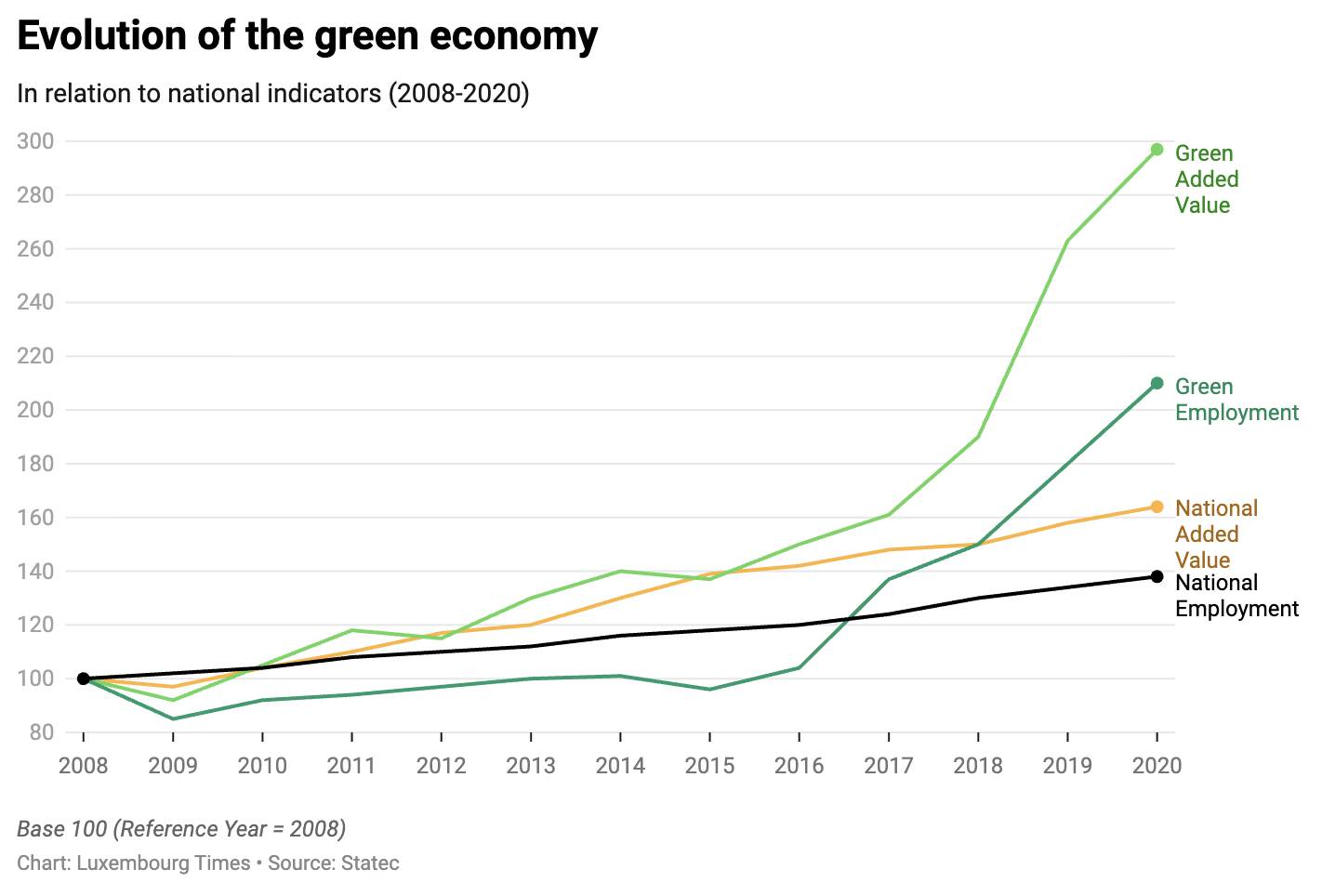
In Luxembourg, the market for green jobs is growing, but still remains a minority. According to an article in Luxembourg Times from 2023, the country's “green” economy have doubled in size since 2017. In addition, the OECD notes that jobs with a significant portion of green tasks represent 31.7% of jobs in Luxembourg, a sign of a strong integration of environmental issues into jobs.
The Luxembourg political framework sets ambitious goals to stimulate this market: the National Integrated Energy and Climate Plan (PNEC) (2021-2030) aims in particular to create thousands of additional jobs in the energy transition and sustainable mobility sectors.
Les most dynamic sectors are:
- Sustainable construction (energy renovation, insulation, smart buildings)
- Renewable energies (solar, biomass, geothermal)
- Green mobility (electric vehicles, charging infrastructure, green logistics)
This sectoral diversification creates new opportunities in the country, but also requires investments in skills and training.
The challenges of recruiting in green jobs
Despite growing demand, Luxembourg companies are facing difficulties in recruiting suitable profiles. ADEM reports significant tensions in particular on the following functions: environmental engineer, HVAC (Heating, Ventilation, Air Conditioning) technician, energy efficiency expert.
A situation confirmed by the OECD: In Luxembourg, green jobs represent on average 17% more vacancies per person employed than the average job.
These difficulties are explained by several factors:
- Lack of initial training specific to green professions or little visibility of these paths
- Rapid change in skills: a green job today can be very different from the one it was five years ago
- Attractiveness of jobs: some positions are technically demanding or not very visible (renovation, maintenance), which can hinder entry
- International mobility: Luxembourg attracts a lot of foreign workers (more than 40% of the workforce) who sometimes have to retrain.
Focus: from the ‘Fit 4 Green Jobs’ initiative to ‘Fit 4 Sustainability’
To address these challenges, measures have been put in place: the national ‘Fit 4 Green Jobs’ programme (now Fit 4 Green & Build Jobs) was a Luxembourg initiative running from 2015 to 2020 aimed at helping young unemployed people find jobs in the green economy sector. It offered nine training courses in the construction sector (see video below), retraining assistance, and public-private partnerships between companies and training centres.
Since then, the Fit 4 Sustainability programme has taken over, encouraging companies to improve their environmental performance and sustainability through consultations funded in part by the Ministry of the Economy.
The future of green jobs: between innovation and requalification
Transitioning to a greener economy is about more than creating new jobs. It also involves the transformation of existing jobs. The OECD “Skills Strategy Luxembourg” report emphasizes that new green jobs will be created, while some existing jobs could be eliminated or transformed in terms of daily tasks.
So, one of the major challenges is the development of skills (“upskilling”) and the retraining (“reskilling”) of employees whose tasks will evolve towards greener requirements. According to a study on training policies, ADEM is developing continuing training and retraining measures for job seekers and employees undergoing retraining.
Among the strategic paths:
- Develop the transversal green skills : energy management, eco-design, environmental assessment
- Encourage the Education-Business partnerships, to adapt the training courses to the concrete needs of the field
- Strengthen the territorial governance green employment: some green jobs are geographically concentrated (industrial areas, urban peripheries)
- Promote theinclusiveness : attracting women, foreigners, young people, in sectors that are often technical or not very feminized.
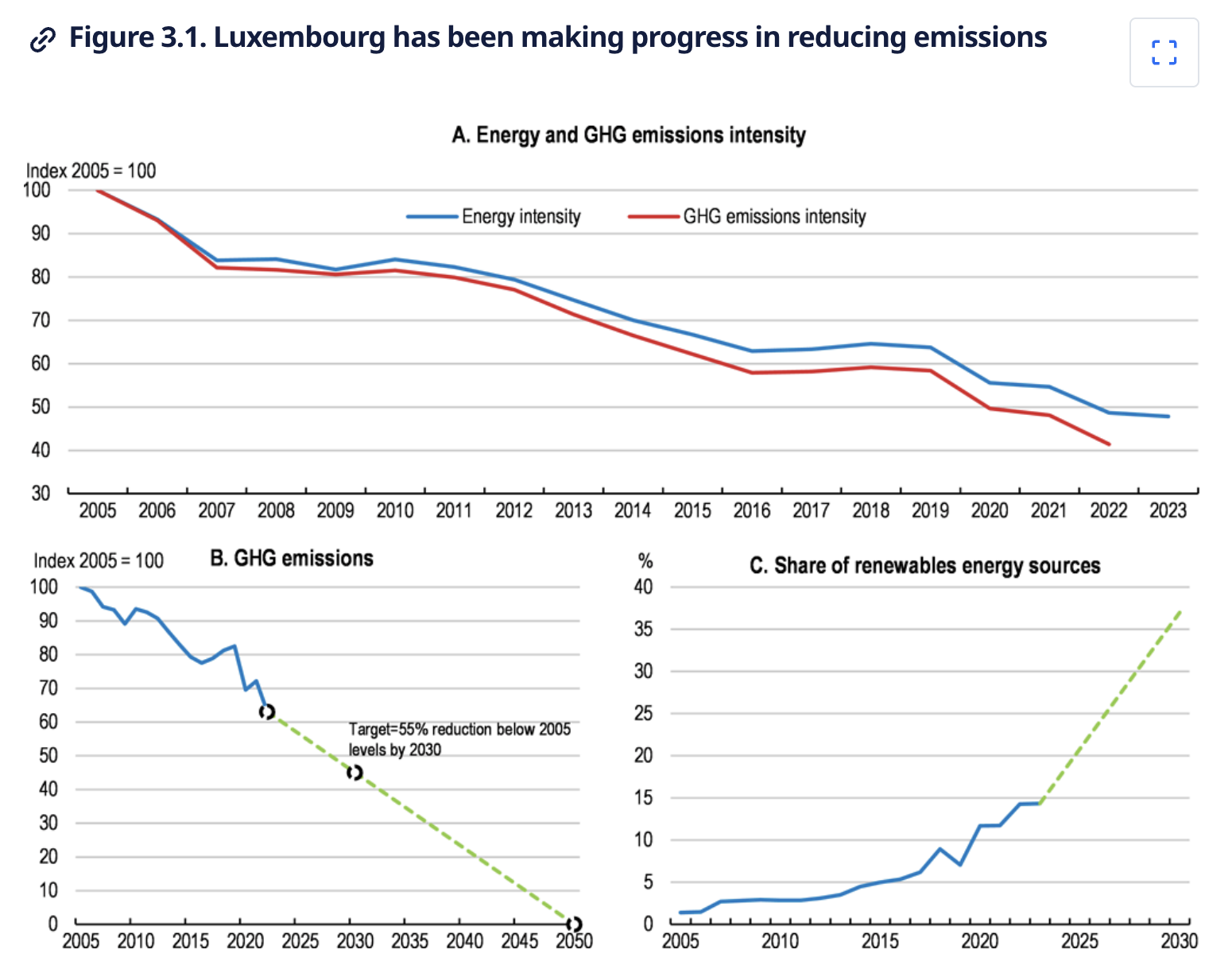
In addition, technological innovation opens up new opportunities: smart buildings, energy networks (smart grids), autonomous mobility. Luxembourg, which is moving towards carbon neutrality by 2050, must align its green employment strategies with its climate goals: the climate law adopted in December 2020 sets a 55% reduction in emissions in non-ETS sectors by 2030 (see below).
Green jobs to watch

Where are green jobs created in Luxembourg?
A geographical analysis provides some perspective, as green jobs are not evenly distributed across Luxembourg.
Urban areas around Luxembourg City are more involved in transition-related services (green finance, smart buildings, engineering). Industrial or peri-urban areas (Esch-sur-Alzette, Differdange), on the other hand, are seeing the development of jobs in production, green logistics and alternative mobility. The sustainable construction sector is particularly active throughout the country: energy renovation of old buildings, insulation, energy efficiency techniques.
Another point to note is that skill profiles vary depending on the sector. For example, in sustainable construction, skills in insulation, energy auditing, site management and new materials are more in demand. In green mobility, skills in charging infrastructure, urban logistics, shared mobility and electrification are particularly sought after. Finally, in renewable energy, the skills that are prioritised are those related to installation, maintenance, network engineering and flow management.
This variation in the skills required by sector means that training courses and careers need to be made more visible to young people and those looking to change careers.
Training for green jobs in Luxembourg
Green job training courses in Luxembourg

These courses allow you to acquire technical skills (installation, maintenance, design) but also transversal skills: project management, CSR, environmental analysis.
Public policies and incentives for green employment
The Grand Duchy is implementing a range of policies to promote the development of green jobs:
- The 2021-2030 PNEC plan sets ambitious goals for the energy transition, which induces a pool of jobs to be condensed.
- ADEM, through its training programs, partnerships and its role as an intermediary on the labour market, plays a central role in orienting people towards green jobs.
- The country also adopted in December 2020 one Climate law which is committed to reducing greenhouse gas emissions by 55% by 2030 (excluding ETS sector) and to achieve carbon neutrality by 2050.
- European and national funds support workforce retraining programmes, research and innovation in green technologies.
For companies, this means incentives for training, the implementation of sustainable practices, and collaboration with training organizations or ADEM. These policies reinforce the attractiveness of green jobs, but also require a structured response in terms of training and vocational guidance.
In Luxembourg, green jobs now represent a major opportunity to support the ecological transition, diversify the economy and adapt skills. Although the exact share of green jobs is still difficult to measure, the indicators converge on sustained growth, strong sectoral dynamics (sustainable construction, renewable energies, mobility) and a clear need for training and retraining.
The challenges remain numerous: recruitment of qualified profiles, visibility of career paths, adaptation of skills and geographical coherence. However, with an active policy framework and ongoing training initiatives, The country is well positioned to make the development of green jobs a lever for competitiveness and sustainability.
FAQ
How do you identify if a job is “green” or “greening”?
It is necessary to examine whether employment missions contribute directly to the preservation/restoration of the environment or whether they incorporate green spots (e.g.: energy audit, solar panel installation, green logistics). “Greening jobs” are existing ones that are evolving towards a greater environmental dimension. The OECD recalls that a frequent criterion is “at least 10% of tasks classified as green”.
What profiles and skills are the most sought after for green jobs in Luxembourg?
Technical profiles (environmental engineer, HVAC (Heating, Ventilation, Air Conditioning) technician, renewable energy maintenance) are in high demand. But also transversal skills: energy audit, sustainable project management, ecological materials, green logistics. The challenge is to train or reconvert employees to these skills. ADEM and training partners are orienting their systems in this direction.
Are there geographic or sectoral disparities for green jobs?
Yes. Green jobs are not evenly distributed: urban areas are more oriented towards green services, peri-urban areas are more oriented towards green production or logistics. Sectorally, the construction, energy and mobility sectors are among the most affected. The OECD indicates that even in Luxembourg, the share of jobs with green tasks varies from region to region.
Useful links
- ADEM (Agency for the Development of Employment)
- STATEC (Luxembourg National Statistics)
- OECD Skills Strategy Luxembourg