This article is part of our monthly series: “Green jobs in Luxembourg”.
Each Tuesday, find a different article on our site:
- Everything you need to know about green jobs in Luxembourg (read here)
- Training and retraining: the keys to accessing green jobs
- Green jobs: 3 sectors undergoing major transformation in Luxembourg (read here)
- Businesses in Luxembourg: who is really banking on the green economy? (read here)
Luxembourg is banking on increasing the skills of its workforce to support the ecological transition. Focus on systems, training and opportunities to train for green jobs, in a context where the transformation of jobs is accelerating.
Training, a driver of the green transition
In a context of profound transformation of the economy and the labour market, training plays a major role.
In fact, as indicated by National Institute for the Development of Continuing Vocational Training (INFPC), “skills for a green economy include... transversal skills”, skills specific to jobs related to ecological transition and highly specialized skills such as renewable energies or recycling.
In Luxembourg, companies are encouraged to invest in vocational training, in particular through grants for continuing training, state co-financing, and schemes that make it possible to reorient employees towards more sustainable functions. The portal lifelong-learning.lu allows employees and individuals to identify available training and assistance.
This increase in skills is essential: according to the report by the Organization for Economic Cooperation and Development (OECD) “How green are regional labour markets in Luxembourg? ”, around 31.7% of Luxembourg workers work in jobs that include green tasks (see our previous article Everything you need to know about green jobs in Luxembourg).
Thus, training is no longer just an individual issue but a collective lever for the national economy to evolve towards a more sustainable trajectory.
The flagship reconversion and orientation devices
Two particularly emblematic devices in Luxembourg deserve attention:
The Fit 4 Green Jobs Program
This program, supported by the Agency for the Development of Employment (ADEM) and the Ministry of Labour, aims to support the reconversion to jobs linked to the ecological transition : environmental engineering, eco-construction, recycling, sustainable mobility.
Although detailed public data is limited, this type of system places training as a pivot of professional reorientation. Past programs such as Fit 4 Green/Build Jobs have already targeted the training of job seekers for the construction and energy sectors.
The Digital Skills Bridge Program
At the same time, digital technology has a place in the transition: this system integrates a “green” dimension by targeting digital jobs with low environmental impact or high energy efficiency potential.
This double entry makes it possible to broaden the spectrum of possible routes. These systems contribute to creating a more flexible and more resilient work environment, where retraining towards “green” functions is made possible through support, training and the recognition of previous skills.
Higher education and research are mobilizing
The higher education sector is not left behind. The University of Luxembourg, in partnership with the Luxembourg Institute of Science and Technology (LIST) and other institutions, is developing specialized courses: master's degree in environmental engineering, certifications in circular economy, energy management, etc. LIST's 2023 annual report underlines its commitment to technologies and studies that are “environmentally friendly and adapted to our future”.
In addition, the OECD points out that The development of skills adapted to the ecological transition is a national priority : “new “green jobs” will be created, [...] while some existing jobs could be eliminated or transformed into terms of daily tasks”.
The challenge is therefore twofold: to train new entrants but also to adapt existing courses so that they are in line with the needs of the green economy.
This integration of higher education, applied research, and continuing education is critical to building a competent and adaptable “green” workforce.
Requalification, employability and HR challenges
Businesses and human resources departments need to rethink their approach.
The recruitment is no longer limited to the search for a “green” job but to the assessment of specific skills: energy audit, maintenance of renewable technologies, sustainable logistics, etc.
THEemployability involves recognizing transferable skills: a maintenance technician can become a solar panel installation technician, provided he has adequate training.
The HR challenge is based on the identification of internal talents, internal training, the valorization of trajectories and the retention of employees in professions that are rapidly evolving.
The Observatory on the training ofINFPC analyzes this change in companies: “In 2021, companies that seek State aid to finance their training plan invest 1.3% of their payroll in training.”
Finally, the geographical and cross-border dimension of the Luxembourg labour market requires companies to broaden their HR approaches beyond national borders.
The key skills of green jobs
To succeed in green jobs, a set of skills is now essential:
- Technical skills : installation and maintenance of renewable equipment, energy audit, use of sustainable materials.
- Transversal skills : ability to “think green”, sense of environmental impact analysis, sustainable project management. The INFPC states that green skills “are also called skills for the green transition or green skills”.
- Digital skills : green technologies are often connected (smart grids, smart building), which implies an interface between green and digital.
The recomposition of skills requires new hybrid profiles, combining technical know-how, environmental awareness and management skills.
Training courses and access procedures
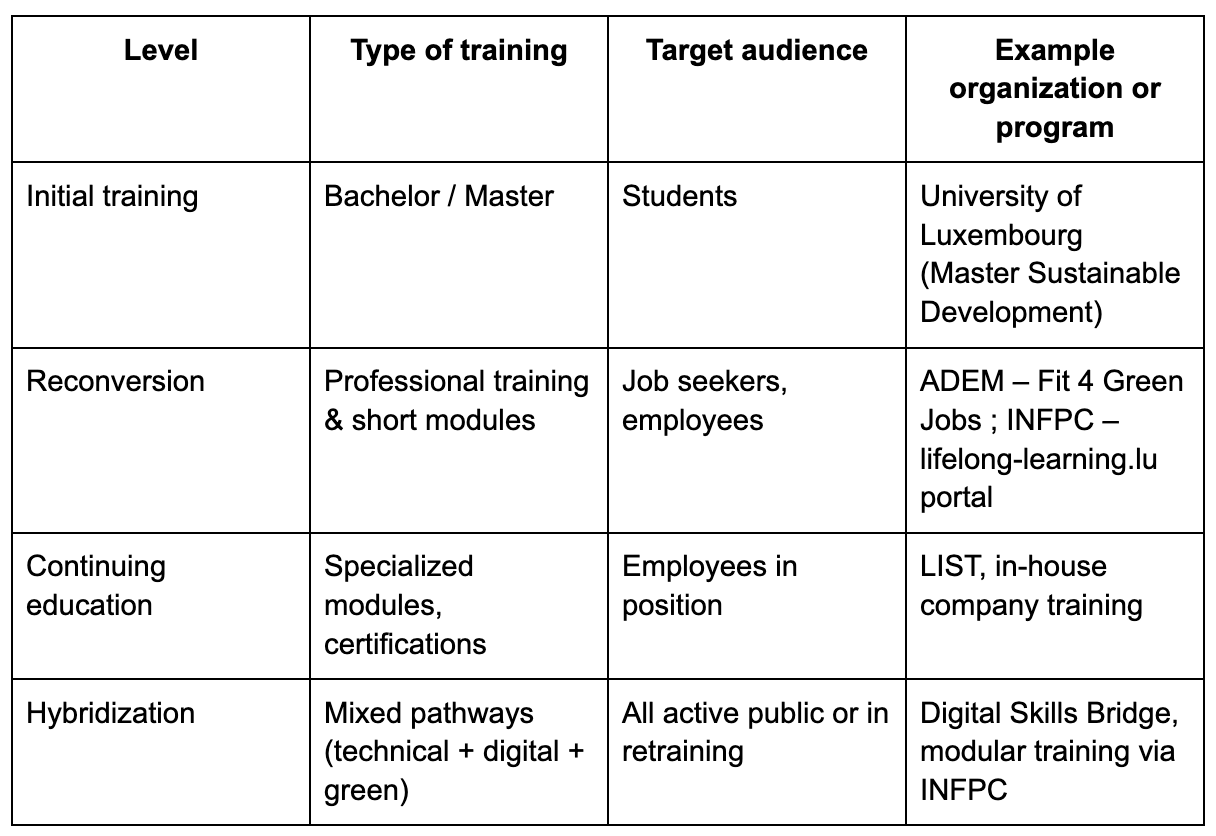
Access is facilitated through financial aid, state-company co-financing, training leave, and guidance via INFPC or ADEM. In addition, the link between professional retraining and career development is highlighted: we are only waiting for change by the traditional way, but we are actively supporting mobility between sectors.
Sectoral opportunities and prospects for future entrants
There are multiple opportunities in many sectors.
In the sustainable construction, the energy renovation of buildings (thermal insulation, intelligent management) is an important vector.
In the renewables, the installation, maintenance and management of networks are in high demand.
In the green mobility, electrification, urban logistics and vehicle sharing are creating new profiles.
For example, the study “Global Entrepreneurship Monitor Luxembourg 2023-24" reveals that 66% of entrepreneurs say they are committed to reducing their environmental impact.
These dynamics are real entry points for candidates motivated to reposition themselves or to start a new “green” career. At the same time, employers must take care to anticipate needs, adapt the training offer and make jobs attractive.
Training and retraining are essential strategic axes to enable Luxembourg to successfully transition to a greener economy.
By mobilizing appropriate mechanisms, by investing in skills, and by adopting a “human” vision of jobs (reorientation, skills development, valorization), it is possible to build a sustainable and competitive workforce.
For HR professionals, trainers and candidates, it is time for action: the transformation of jobs is under way, it is a question of preparing for it.
FAQS
Who can benefit from retraining schemes to green jobs?
Job seekers, current employees, people undergoing professional retraining can access devices such as Fit 4 Green Jobs, or the modules offered via the INFPC. The important thing is to identify the appropriate training courses, to check the assistance available and to commit to a course compatible with your objectives.
How long does it take to train for a green profession?
It depends on the level and the targeted profession. A short course can last a few months (certification modules), while a full course (Bachelor/Master) can take several years. Retraining programs often aim to make them operational by 6 to 18 months, based on experience and commitment.
What are the criteria for choosing a good course in this field?
It is necessary to check that the training is recognized and eligible for aid (INFPC, co-financing), that it covers the technical and transversal skills useful for green jobs, that the opportunity is real (active sector, employment in tension), and that the training organization offers support (reorientation, coaching). The INFPC Training Observatory is a useful resource for comparing offers and monitoring trends.