Luxembourg is often cited as one of the countries offering one of the highest average salaries in Europe. Every year, the Grand Duchy attracts numerous qualified workers in search of a better standard of living.
But beyond the minimum wage, what about the remuneration of the various sectors? What are the differences between skilled and unskilled workers?
The average salary in Luxembourg
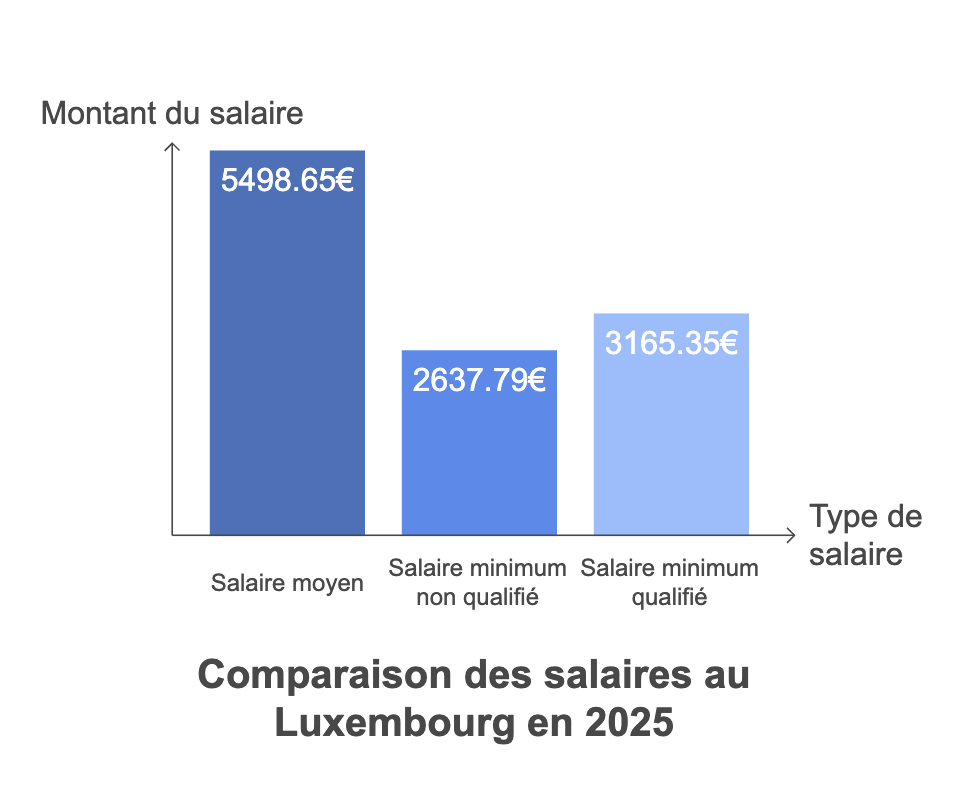
In 2025, the average salary in Luxembourg is €75,919 gross per year (source: statistics.public.lu).
This remuneration varies according to the sector of activity, the experience and the level of qualification of the workers. For example, the finance, law, and information technology sectors offer salaries that are higher than the national average.
The minimum wage
The social minimum wage (SSM) in Luxembourg is one of the highest in Europe. Since January 1, 2025, it has risen to 2 637.79€ gross per month for unskilled workers and at 3,165.35€ for skilled workers. This distinction aims to recognize the specific skills and qualifications of employees.
Wage and inflation
Luxembourg applies an automatic wage indexation system to maintain purchasing power in the face of inflation. In February 2025, the annual inflation rate was 1.7%, down slightly compared to the previous month. A wage indexation was triggered in May 2025, leading to a 2.5% increase in earnings.
Salary differences between residents, cross-border workers and expatriates
Luxembourg attracts a varied workforce: Luxembourg residents, cross-border workers and expatriates. While salaries are attractive for everyone, differences exist in net pay, taxation and benefits.
Salaries of Luxembourg residents
- Higher salaries than cross-border workers, with an average difference of 21.5%
- Facilitated access to positions of responsibility, especially in the public service and large Luxembourg companies
- An automatic wage indexation system, which protects purchasing power against inflation
- Full social benefits, including housing benefits, family allowances and various tax benefits
- A simplified administrative situation, without the obligation of double tax declarations
Wages for cross-border workers
Cross-border workers represent nearly 50% of the country's employees, with around 226,000 workers coming from France, Belgium and Germany.
Here are some differences with residents and expats:
- Wages 21.5% lower than residents
- High dependence on road traffic at borders, often extending daily travel time
- No access to certain housing benefits or social benefits reserved for residents
- Different tax regime depending on the country of residence, sometimes with an additional tax return
Cross-border workers thus benefit from the Luxembourg salary while benefiting from a lower cost of living in their country of origin. However, taxation varies according to bilateral tax agreements, and teleworking is limited by tax thresholds that require working a minimum number of days in Luxembourg in order not to be taxed elsewhere (34 days of teleworking per year maximum per year for French workers for example).
Expatriate salaries and international senior managers
Expatriates often come to Luxembourg for management positions, in sectors such as finance, tech and audit.
Their differences?
- Salaries well above the national average, especially for managers and international experts
- Possibility to negotiate complete packages with mobility grants, performance bonuses and company accommodation
- Privileged access to international schools, often supported by the company
- Optimized tax status according to the type of contract signed, sometimes avoiding certain charges
Expatriates benefit from attractive contracts, but their integration into the Luxembourg job market often depends on their ability to adapt to local requirements, especially in terms of multilingualism and tax regulations.
Why are salaries high in Luxembourg?
If you are wondering why salaries are so high in Luxembourg, the reasons are explained by several factors: a strong presence of international companies, a competitive job market and an indexing system that regularly adjusts remuneration.
The country is looking to attract qualified workers, which is pushing employers to offer high salaries to remain competitive.
Understanding the overall remuneration structure in Luxembourg
The gross salary displayed on an employment contract does not correspond to the income actually received by the employee.
Several factors influence the final remuneration and explain the level of employees:
Wage indexation
A central mechanism of the Luxembourg system. When inflation reaches 2.5% all wages are automatically increased to maintain purchasing power. This measure concerns both the minimum wage and higher salaries.
The social security system
A percentage of the gross salary is taken to finance:
- Social security
- Health insurance
- Retirement pensions
- Family benefits
- Unemployment insurance
On average, an employee pays between 12 and 14% of his gross salary in contributions, while employers must also pay employer contributions, which finance in particular social security, accident insurance and vocational training.
Benefits in kind and bonuses
To supplement remuneration, employers also offer restaurant tickets, company cars, private health insurance or performance bonuses. Finally, income tax, which is deducted directly from the gross salary, varies according to family situation and annual income.
An entire structure that allows Luxembourg to guarantee attractive incomes and comprehensive social protection.
The cost of living in Luxembourg
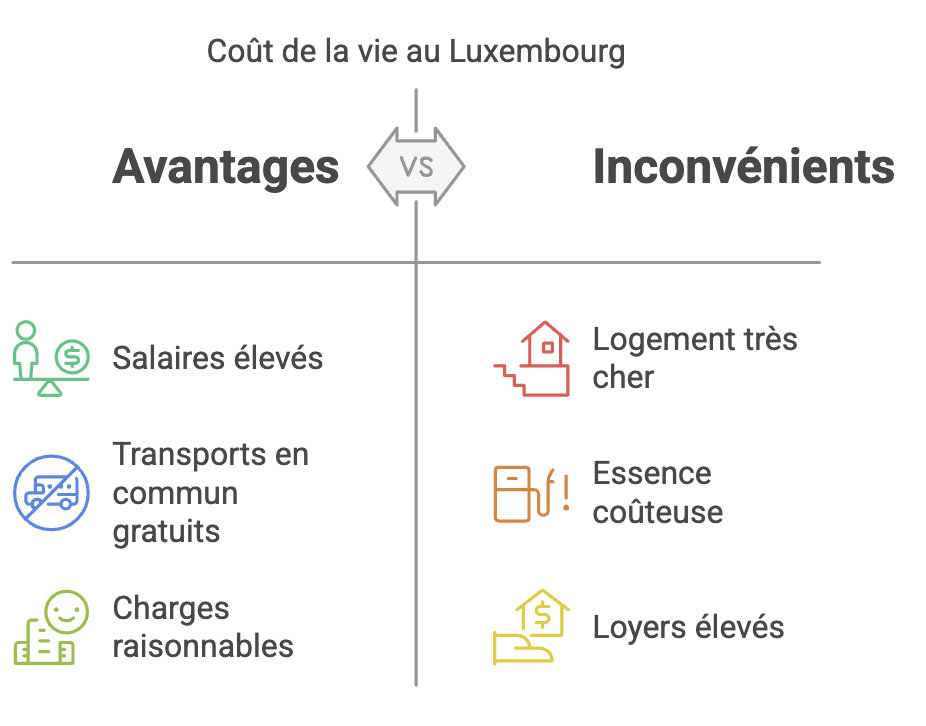
A country with such a high salary obviously listens to you when it comes to the cost of living. Housing represents a significant part of workers' expenses, and prices are often higher than in France, Belgium or Germany.
Some figures on the cost of living to help you better understand:
The housing
- Purchase: €10,000/m² on average, up to €800,000 for a one-bedroom apartment (source: luxtoday.lu)
- Rent: €33.53/m² on average, €39/m² in the capital (source: bgl.lu)
Transport
- Gasoline: €1.51/L (source: numbeo.com)
- Public transport: free for all residents and border workers
Charges and services
- Bills (water, electricity, heating): ~230 €/month for an 85 m² apartment (source: luxtoday.lu)
-
Comparison of wages with border countries:
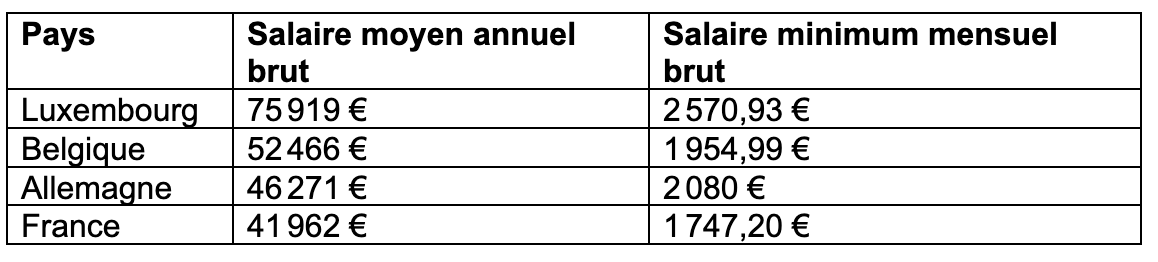
These figures show that Luxembourg offers average wages and minimum wages that are higher than those of its neighbours, reflecting an attractive wage policy.
In Luxembourg, Average household income Is of €50,000/year, the highest of the OECD countries (source: luxemburg.public.lu).
Remuneration in Luxembourg by sector and by profession
Working in Luxembourg is the guarantee of an attractive remuneration. But beware, not all sectors are the same. Some have salaries well above average, and some jobs are doing particularly well.
So in concrete terms, which sectors and jobs offer the highest salaries in 2025?
The most profitable sectors
The numbers speak for themselves: some sectors in Luxembourg offer gross annual salaries that make you dream, especially when you are qualified and experienced.
- Finance and insurance: with an average gross annual salary of €113,018, the financial sector remains unsurprisingly one of the most attractive. The presence of major international insurance banks and the country's position as a true European financial hub explain these generous salaries. This sector also offers professional stability thanks to a strong collective agreement and advantageous employment contracts.
- Teaching: if you thought that teaching was not profitable, think again. The education sector in Luxembourg has an impressive average salary of €111,362 per year. The reason: a high valuation of qualifications, an advantageous salary scale and an ambitious education and vocational training policy.
- IT and engineering: In the tech sector, salaries are soaring rapidly. According to a recent study by Hays, specialized IT profiles can reach salaries of up to €180,000 per year. Why? Because these jobs are highly sought after by Luxembourg companies, with a dynamic job market and a lack of technical and digital talent.
But be careful: these very high salaries depend on the position held, the company that employs, the level of qualification and professional experience. Not to mention that these attractive salaries often go hand in hand with a high level of training requirements (recognized diplomas, specific certificates, etc.).
The best paid jobs
Beyond sectors, certain specific jobs in Luxembourg guarantee remuneration that is higher than average.
The main jobs that pay the most:
- Risk Manager : a key figure in the company, particularly in the financial sector, he benefits from a salary that can easily exceed 120,000 euros gross per year depending on his experience.
- CFO (Chief Financial Officer) : the financial manager of a company in Luxembourg benefits from a gross annual salary of between 130,000 and 200,000 euros, depending on the size of the company and its experience.
- Compliance Officer : highly sought after in the financial and commercial sectors due to strict European regulations, he earns on average between 90,000 and 150,000 euros gross per year, depending on his level of responsibility.
These highly qualified professions combine significant responsibilities, advanced technical requirements and extensive experience. Obviously, these highly profitable jobs are accessible with solid experience, extensive training and an ability to manage the risks and regulatory constraints of the Luxembourg market.
Jobs in shortage according to ADEM (and their attractive salaries)
If your plan is to settle in Luxembourg and you want to quickly secure a job with a good salary, take an interest in so-called shortage jobs. Each year, the Agency for the Development of Employment (ADEM) publishes a list of the professions that recruit the most and offer attractive salaries because of their rarity.
Among the jobs that are currently highly sought after and well paid:
- Specialized IT developer (average annual salary: between 60,000 and 95,000 euros gross)
- Qualified nurse (average annual salary: 70,000 euros gross depending on seniority and qualification)
- Technician specialized in industrial maintenance (average annual salary: between 50,000 and 75,000 euros gross depending on experience)
These jobs suffer from a difficulty in recruiting sufficiently qualified candidates. The result: a steady rise in wages to attract qualified workers from other European countries.
Evolution of salaries with experience and level of qualification
Let's be clear: in Luxembourg, the higher your professional experience and your level of qualification, the more quickly your remuneration increases.
A few things to remember:
- With a higher degree, you benefit from privileged access to management positions or specialized technical functions with an attractive salary from the first years of activity.
- Experience is also decisive: on average, an employee with more than 10 years of experience sees his remuneration increase by 30 to 50% compared to a beginner in the same position
- For skilled workers with specific technical certificates or a Bac + 5 diploma, salary growth can be even faster and significant, especially in the technical or financial sectors.
Conclusion
In the end, your salary in Luxembourg will depend above all on your sector of activity, your profession accurate, but above all of your ability to value your experience and your qualification on the Luxembourg labour market.
Be that as it may, In 2025, Luxembourg remains one of the most attractive European destinations in terms of remuneration, with interesting professional opportunities and a recognized quality of life, despite a high cost of living that should not be underestimated.
Frequently asked questions
What is the average salary in Luxembourg?
The average gross annual salary in Luxembourg in 2025 is €75,919/year.
Which sector offers the highest salaries?
The IT and Engineering sector offers the highest salaries, up to €180,000 per year.
Does an expatriate French earn as much as a Luxembourg resident?
In general, a French expatriate occupying a position of responsibility earns as much or more than a Luxembourg resident thanks to his specific expertise and negotiated advantages.