A country where wages keep up with inflation and guarantee stable purchasing power is a dream, isn't it?
In Luxembourg, the minimum wage is among the highest in Europe, attracting a lot of skilled and unskilled workers every year. With wage indexation and a constantly changing cost of living, the monthly gross amount is constantly being adjusted.
But what changes took place in May 2025? What criteria influence this remuneration? Deciphering the social minimum wage and its impact on working conditions.
Understanding the minimum wage in Luxembourg
Definition of the social minimum wage (SSM)
The social minimum wage is lowest monthly gross amount that an employee can legally receive in Luxembourg. Fixed by the Labor Code, it is revalued according to the indexation of wages, taking into account inflation and the cost of living.
In May 2025, a further increase in wages took place, guaranteeing better remuneration for employees.
The two types of minimum wage: skilled and unskilled
The distinction between skilled and unskilled workers directly influences the amount of the gross wage:
- Unskilled worker : this status concerns employees who do not have a diploma or specific professional experience in their field. Their remuneration corresponds to the basic minimum social wage, with no increase.
- Skilled worker : the qualified worker receives a higher salary and an increase, in recognition of his professional skills. This qualification can be obtained through a recognized diploma, technical training or significant experience validated by the employer.
Minimum wage amounts in 2025
On 1 May 2025, the Luxembourg social minimum wage was reassessed, impacting the monthly gross remuneration of unskilled and qualified workers, as well as young employees.
Young workers are those whose remuneration is calculated as a percentage of the social minimum wage, thus adapting to their age and apprenticeship status.
Summary table of minimum wages in 2025
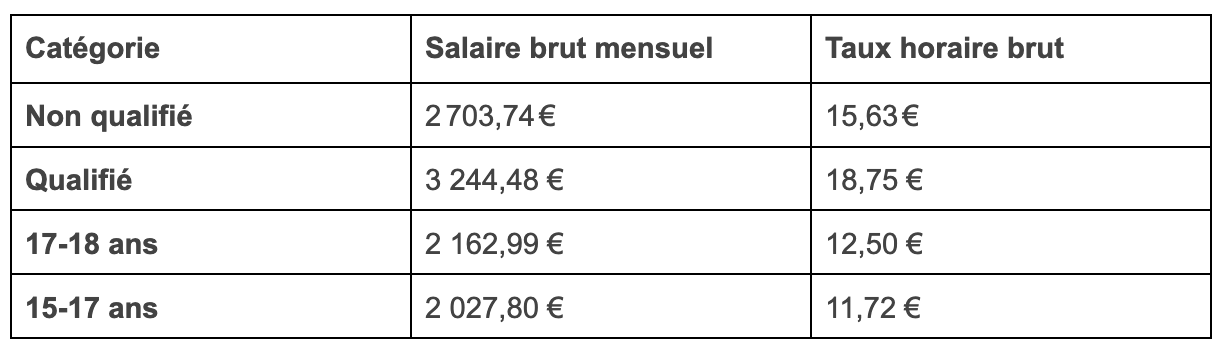
Sources: government.lu, chd.lu
The criteria to be considered a skilled worker
The status of qualified worker allows access to a higher minimum social wage, provided that the criteria defined by the Luxembourg Labour Code are met.
Degrees required
To be considered as such, it is necessary to have a recognized degree or certification. Among the courses accepted:
- Diploma of Professional Aptitude (DAP)
- Technical and Professional Aptitude Certificate (CATP)
- Professional Capacity Certificate (CCP)
- Technical and Professional Initiation Certificate (CITP)
Professional experience required
Without a diploma, an employee can be considered a qualified worker if he has at least 10 years of experience in a specific field, or 6 years if he works in a position requiring advanced technical skills.
Recognition procedures
Foreign workers must obtain diploma recognition from the Luxembourg Ministry of Education. Validation by the employer or a collective agreement can also formalize qualified status.
Indexation and annual review of the minimum wage
The minimum wage (SSM) in Luxembourg is adjusted using two main mechanisms:
- Automatic wage indexation: when the consumer price index increases by 2.5%, wages, including the SSM, are automatically increased by 2.5% to preserve the purchasing power of employees
- Biennial review of the SSM: every two years, the government reassesses the amount of the SSM according to changes in social and economic parameters
As of May 1, 2025, an increase of 2.5% was applied to the SSM, setting the gross monthly salary at:
- €2,703.74 for unskilled workers
- €3,244.48 for skilled workers
These mechanisms ensure regular adaptation of the SSM to economic conditions, thus guaranteeing the purchasing power of employees.
Labour law and collective agreements
Differences between SSM and collective agreement salary grids
Unlike the SSM, which is applicable to all employees, collective agreements:
- Define specific salary scales according to profession and seniority
- May include bonuses and additional benefits
- Offer remuneration adjusted to the complexity of the tasks
Cases where the wage is higher than the legal minimum
In some sectors, employees receive a higher salary through collective bargaining or specific job requirements.
Professional experience, arduous work, or delayed hours may justify these adjustments.
Rights of cross-border workers
Frontier workers enjoy the same wage rights, but must comply with specific regulations:
- Taxation according to agreements between Luxembourg and their country of residence
- Social contributions paid to the Luxembourg system, entitling you to social benefits
- Regulated telework with a limited number of days to avoid a change in the tax regime
Conclusion
The Luxembourg social minimum wage guarantees fair remuneration, both for unskilled workers and for skilled workers, whose skills are better valued.
Thanks to wage indexation, incomes keep up with inflation, offering stability and financial security
With one of Highest SSM in Europe, Luxembourg remains an attractive destination for employees.
Ready to seize an opportunity? Discover the job offers on our site and start your career in Luxembourg!
Frequently asked questions
Is there a minimum wage in Luxembourg?
No, Luxembourg applies a minimum social wage, which varies according to the age and qualifications of the worker.
What is the minimum wage in Luxembourg in 2025?
Since May 2025, it has been €2,703.74 gross monthly for an unskilled worker and €3,244.48 for a skilled worker.
How does the minimum wage change with indexation?
Wage indexing automatically adjusts the SSM when the consumer price index increases by 2.5%, in order to maintain purchasing power.
.jpg&w=1080&q=75)