Loss of motivation, desire for change, the impression of not moving forward: many people are now wondering about their professional life and are looking for an activity that makes more sense for them.
This search for meaning encourages you to explore new paths, to define your priorities, and sometimes even to consider a retraining or a new professional project.
Ikigai (or ikigai) is a Japanese concept born on the island of Okinawa that offers a method to better understand one's life path.
It is based on four pillars:
- What we like,
- What one is good at,
- What you can get paid for,
- What the world needs.
A useful introspection tool for building a coherent professional activity, in line with its values.
This practical guide brings together concrete examples of ikigai, a template to fill out, key questions, and ways to find a fulfilling professional life.
Here are the main elements of ikigai :
- Ikigai Helps to Structure a Reflection Around the Meaning of Work
- It is based on four dimensions: pleasure, skills, use, remuneration
- It is used as a reference point in a professional retraining phase.
- Its application is possible in all areas, at any time in life
Discover an explanatory video on the concept of ikigai:
How does ikigai help with professional retraining?
Understanding Ikigai and its origin
The word ikigai comes from the Japanese “iki” (life) and “gay” (value). It is often translated as “reason to get up in the morning.”
This philosophy of life has its roots in the Okinawa region in southern Japan. An island renowned for the longevity of its inhabitants, their balance of life, and their joy of living. The island has around 68 centenarians per 100,000 inhabitants, one of the highest rates in the world.
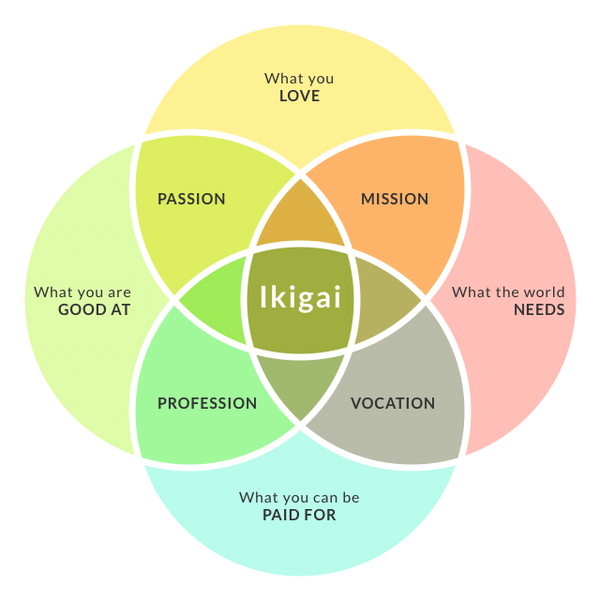
Ikigai is based on the encounter of four fundamental dimensions of our existence.
Each is an essential component in identifying a fulfilling and sustainable professional activity:
- What I like (my interests, my passions)
- What I am good at (my natural skills, my talents)
- What I can get paid for (sources of income or remuneration)
- What the world needs (causes I care about)
At the crossroads of these spheres, we find:
- The passion : located between what I love and what I am good at
- The Mission : Located between What I Love and What the World Needs
- The vocation : located between what the world needs and what I can get paid for
- The profession : located between what I can get paid for and what I am good at
Visualizing your ikigai allows you to see more clearly, to better understand what makes sense, what brings pleasure, in order to build, step by step, a life path aligned with your values and your professional activity.
Why is Ikigai important?
Ikigai usually comes at a time when you don't really recognize yourself in your work anymore. The pace, the tasks, the past choices, no longer corresponds to his desires, or to his personal life. This gap often marks an important stage: the stage where you feel the need to take stock.
Ikigai does not provide an immediate solution, but a simpler way to get back in touch with yourself. In a professional way, it helps to discover what corresponds to his personality, to better understand his abilities, and to think about a profession that is more consistent with his values and desires.
From a personal point of view, the tool helps to get to know each other better, to get out of imposed patterns, and to build a more realistic idea of retraining. Not necessarily to change everything, but to adjust, give meaning, or imagine a more aligned life.
Ikigai Brings You :
- A clear framework for analysing your current situation without judging
- A Better Reading of One's Personal Strengths and How It Works
- Support in the desire to become more independent or to develop your profession
- A more thoughtful reflection on the place of those around him, his priorities, and the rest of his career
Using ikigai often means choosing to move forward in a different way. With more clarity, more coherence, and above all, more interest in what really matters. Each step becomes an opportunity to learn, to correct, to create a better path.
Changing jobs is not just a professional choice: it is often a personal quest.
The need to regain control over one's daily life, to find an environment aligned with one's personality, values, and a certain form of joy in professional activity.
Ikigai is a simple but effective method for taking stock, thinking about what “working with meaning” really means, and creating a project that is both realistic and exciting.
Instead of carrying out a complex test or coaching over several months, a few clear questions are enough to discover what brings pleasure, motivation, and a lasting professional goal.
Some types of structures agree with this approach. :
- Companies on a human scale where relationships and listening are at the heart of the work
- Jobs focused on helping others, health, personal development
- Positions That Leave Room for Autonomy or Practical Creativity
- Environments that Value Social Awareness, Positive Impact or a Taste for a Job Well Done
Each element is important: distance, physical balance, free time, or even the possibility of developing one's abilities within the organization.
Ikigai can also make a difference during an interview: if you have a clear vision of what you are looking for, an ability to explain your choices, to show what you want to achieve, you will create a better human connection with your recruiter.
7 Inspiring Examples of Ikigai
Your ikigai will be different depending on your past and future aspirations. What counts is the desire to move towards a life full of meaning, in accordance with one's desires, abilities, and the needs of the world.
Here are 7 concrete examples of ikigai based on jobs in high demand in Luxembourg, to illustrate how this ikigai method can guide a reconversion project, or simply inform a choice.
Ikigai example #1: IT developer
- What I like : Solve Technical Problems and Create Tools
- What I am good at : code, structure, automated interfaces
- What the world needs : reliable and accessible digital services
- What Can I Get Paid For : software developer for businesses and users
Maxime found his professional ikigai at a tech startup located in Esch-sur-Alzette. His work animates him and corresponds to his logic and his desire to contribute to a better world.
Ikigai example #2: Accountant
- What I like : understand, organize, structure
- What I am good at : precision, logic, mastery of numbers
- What the world needs : transparent financial management
- What Can I Get Paid For : supporting businesses in their accounting
Sandra likes SMEs seriously and listens. She has found complete fulfilment in a technical but deeply human job.
Ikigai example #3: Nurse
- What I like : to be in contact with patients, to help, to relieve
- What I am good at : empathy, precise gestures, adaptation
- What the world needs : quality care and human support
- What Can I Get Paid For : providing care within a health institution
Julie works in a public hospital in Luxembourg. Her vocation was born after a personal assessment, and every day, she works with enthusiasm.
Ikigai example #4: Roofer
- What I like : Working Outside, Seeing the Results with My Hands
- What I am good at : repair, climb, coordinate
- What the world needs : safe and well-maintained buildings
- What Can I Get Paid For : Install and renovate roofs
Ali successfully retrained after a quick search. This manual and concrete job offers him a high level of satisfaction.
Ikigai example #5: Management consultant
- What I like : solve complex situations
- What I am good at : structure, analysis, guide
- What the world needs : better managed organizations
- What Can I Get Paid For : provide advice to businesses
Claire found her own way by combining listening, strategy and impact.
Ikigai example #6: Bank Risk Analyst
- What I like : protect, anticipate, secure
- What I am good at : detecting weak signals, cross-referencing data
- What the world needs: responsible and reliable banks
- What Can I Get Paid For : assess investment risks
Lucie has trained extensively, and has built a tailor-made job where she feels useful and recognized.
Ikigai example #7: IT Project Manager
- What I like : coordinate, structure, advance ideas
- What I am good at : organization, overall vision, communication
- What the world needs : well-conducted digital projects
- What Can I Get Paid For : manage tech teams and deliver solutions
Elodie manages international projects in a company located in Luxembourg city. What drives it? Team work and the pleasure of getting things done.
As we can see through these examples, there is no single profile for career success. But by taking the time to listen to what really brings us, we can work with more consistency, passion, and sometimes even joy.
Ikigai is not a checkbox, it is a path to be clarified, a simple method to take stock and move towards a more lively professional life.
How do you fill out your ikigai?
Getting to know yourself better is often the starting point to develop your career, breathe new life into your mission or find meaning in your daily life. The concept of professional ikigai allows you to identify what you do best, what motivates you, what you can contribute to people, and where to go to make your work a personal success.
Here are a few concrete questions to move forward in this reflection. :
- What activities are fun and would you like to do more often?
- What talents do you naturally recognize (by your loved ones, colleagues, customers)?
- In what situations did you really feel that you had achieved something that mattered?
- Where do you feel aligned, in harmony, with yourself and your environment?
- How could what you do help others or have an impact on daily life?
- What would be the joy of being able to wake up every morning for something that makes sense?
These answers can be a start, a clearer direction for improving your quality of life and overall satisfaction.
A simple exercise in 4 steps :
- List your daily pleasures, without judgment
- Name the skills or know-how that people recognize in you
- Identify topics or causes where you would like to have a positive impact
- Cross this data to make your professional ikigai emerge
👉 Download our fillable PDF canvas, a clear tool to move forward at your own pace towards greater meaning and personal alignment.
Reflecting on your ikigai is taking a moment to reconnect with what is important to us.
Thanks to this method, you will rethink your lifestyle, your desires, and the way in which you want to contribute to your professional career.
Those who have taken this step often report a sense of success and a better quality of life. It also allows you to regain confidence in your choices, and in your ability to move in a more just direction.
Frequently asked questions
How does ikigai affect daily life?
It helps to better guide your choices, to feel more useful and to regain energy on a daily basis.
Can ikigai evolve over time?
Yes, it evolves according to your experiences, your desires and your lifestyle.
How do I know if I have found my Ikigai?
When you care about what you do, makes sense, and naturally motivates you, you're on the right track.
Can we have several ikigai?
Yes, some people have several depending on the periods of life or the roles they occupy.