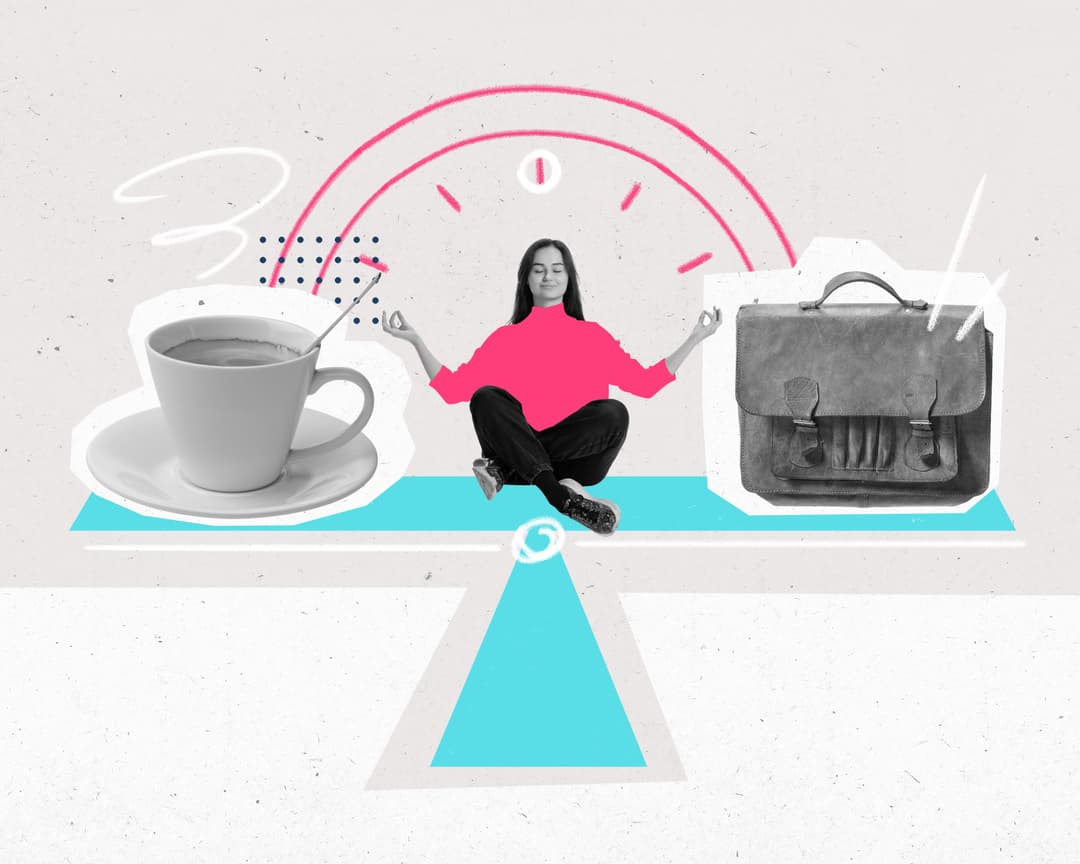
The balance between professional and personal life has become an essential subject in organizations. And for good reason: in an environment that is increasingly demanding, hyper-connected and subject to strong economic and social pressures, knowing how to maintain this balance has become a public health issue as well as a performance driver for companies.
For a long time, it was accepted and even valued that professional involvement should take precedence over the rest.
But today, this approach is showing its limits. Chronic fatigue, loss of motivation, personal tensions... the signs of an imbalance are multiple and often invisible until the breaking point. It is therefore becoming essential to rethink the way in which we organize work, both individually and collectively.
Constant pressure and hyper-connection: a difficult modern context
The current work context is marked by two major trends: the continuous rise in performance and the disappearance of physical borders thanks to digital tools. Employees are connected all the time, and can be reached everywhere, all the time. Slack notifications, late emails, video conferences outside of regular hours...
This “permanent availability” is often interpreted as a sign of commitment. However, it creates a mental load that does not say its name.
The phenomenon affects all professional categories, including senior managers, who are also struggling to drop out. At the same time, teleworking, while offering a certain flexibility, has also contributed to blurring the boundaries. The home is becoming an extension of the office, and the right to disconnect is still too often theoretical.
The positive effects of a good balance on health and productivity
On the other hand, maintaining a clear separation between professional and personal life has measurable effects:
- A better concentration : attention is more sustained when the mind is not saturated.
- One stress reduction : less pressure, less physical or mental tension.
- One sustainable motivation : employees who have a good balance are more involved, because their energy is better distributed.
- One prevention of psychosocial risks, including burn-out.
Far from being a luxury, this balance is a condition of performance. It also allows talent to be retained: companies that take care of this aspect attract quality, more stable and more committed profiles.
The consequences of a prolonged imbalance
When an employee exceeds their limits on an ongoing basis, the effects are rarely immediate, but they accumulate insidiously:
- Chronic fatigue, difficulty concentrating
- Sleep disorders, anxiety, irritability
- Family conflicts or social isolation
- Decrease in performance, more frequent mistakes, demotivation
Ultimately, these symptoms can lead to professional or personal burnout. The cost is high, both for the individual and for the organization (absenteeism, turnover, loss of productivity).
Common causes of a work/life imbalance
An unevenly distributed workload
Too many poorly defined responsibilities, tasks accumulated without prioritization, or even an inability to delegate are major obstacles. Some employees also find it difficult to set limits, for fear of disappointing, or because they associate success with unwavering commitment.
Employee over-engagement can become a vicious circle: the more you invest, the more missions you receive... until saturation is reached.
Blurred boundaries between professional life and private life
Teleworking, if properly supervised, can contribute to balance. But in many cases, it makes it more difficult to separate the spheres. The temptation to “respond quickly” to a message in the evening, or to leave the family aside to finish a file after dinner, is strong. The result: you never really pick up.
The absence of a dedicated place to work or a fixed time frame worsens this phenomenon. Working from your bedroom or in a noisy environment can affect quality of life as well as productivity.
A work environment that is not very flexible
Rigid schedules, frequent trips, meetings imposed at unsuitable hours... Organizational constraints sometimes severely restrict the possibility of adapting one's work rhythm to one's personal needs.
In some companies, the face-to-face culture is still well established: you have to “be there”, even if this does not guarantee effectiveness or real involvement. This mentality hampers managerial innovation and fuels imbalance.
Misaligned social and family expectations
Social or cultural norms can also complicate balance in the family. For example, the distribution of domestic tasks is still often unbalanced, which weighs particularly on certain categories (women, carers, single parents, etc.).
Added to this are external injunctions: succeed professionally, be an involved parent, maintain an active social life... all roles to be reconciled with a day that does not exceed 24 hours.
10 concrete tips for a better work/life balance
1 - Set clear boundaries between work and personal life
Defining specific work schedules is an essential first step in maintaining balance. It's not just about finishing at 6 p.m., but about actually sticking to it.
This involves planning, but also through communication with your team and hierarchy. By clearly setting your boundaries, you are also encouraging a culture of respect for everyone's time.
Saying stop at a certain time, even when working from home, allows you to find mental space for your personal life.
2 - Arrange your schedule in a realistic way
A full agenda is rarely synonymous with efficiency. Continuing meetings, without breaks or breathing, exhausts concentration and increases stress.
Plan transition periods between two tasks, leave room for the unexpected, and don't underestimate the time needed to get it right. A well-thought-out schedule is a tool for peace of mind and not a source of pressure.
3 - Disconnect completely after work
Disconnection is a right, but also a discipline. And it's all the more difficult in a world of work redefined by technology.
Turning off professional notifications, closing your computer or even changing rooms when you work from home are simple but powerful gestures. They mark a psychological break necessary to allow the brain to move on. Going out for a walk, doing a manual activity or simply taking the time to do nothing: this is how you recharge your batteries.
4 - Delegate and learn to say no
Many imbalances are the result of too much responsibility. However, wanting to do everything yourself leads to exhaustion. Delegating is not an admission of weakness, but a proof of lucidity. This allows you to focus on what has the most impact.
Knowing how to say no to certain requests, in a reasoned and respectful way, is also essential to preserve your energy and efficiency in the long term.
5 - Practice regular physical activity
Physical activity is a natural antidote to stress. It improves the quality of sleep, stimulates concentration and promotes better emotional balance.
There is no need to become a marathon runner: a simple 30-minute daily walk, a yoga session or a few stretches are enough to relaunch the mechanisms of well-being. Integrating movement into your daily routine means offering your body and mind a decompression valve.
6 - Give time to your passions and hobbies
We all need spaces where we do things for ourselves, without performance goals. Reading, cooking, playing music, gardening... these activities nourish inner balance.
They also make it possible to regain a form of self-presence, often overlooked in the frenzied rhythms of daily life. Dedicating yourself to your passions, even a few hours a week, also means cultivating your creativity and your joy of life.
7 - Use digital tools sparingly
Digital tools are useful, but overusing them quickly becomes toxic. They capture attention, promote constant interruption, and artificially prolong workdays.
It is essential to set times without screens, to limit unnecessary requests, and to optimize exchanges (for example, by grouping messages instead of multiplying emails). Good use of digital technology also requires meetings that are shorter, more targeted, and really useful.
8 - Rethinking your concept of performance
In a society that values speed and quantity, it is tempting to combine performance with constant availability. However, the most efficient employees are often those who know how to protect themselves.
Sustainable performance is based on balance, clarity of priorities and the ability to maintain a high level of energy over time. Thinking about your own definition of success can be a great starting point to get out of the myth of “always more.”
9 - Ask for support if necessary
Knowing how to ask for help is a strength. Whether with HR, your manager, a colleague or an external professional, it is important to be able to express your difficulties before they become critical.
Companies that encourage free speech and offer spaces for discussion about mental load or life balance are also the ones that best retain their talents. Support should never be seen as a sign of weakness, but as a lever for adjustment.
10 - Set up daily wellness routines
Routines create stable reference points in days that are often unpredictable. They allow you to start the day on the right foot, regulate moments of tension and end the day gently.
It can be a morning ritual (reading, meditation, hot drink without a screen), micro-breaks during the day, or a moment of gratitude in the evening. These habits, simple on the surface, have a profound impact on the quality of life at and outside of work.
Take the test: assess your own balance in 5 questions
Take our test to measure your work/life balance!
Do you regularly think about work during your time off or with family?
- 🟩 Never
- 🟨 Sometimes
- 🟥 Often
Do you have trouble taking time just for yourself, without any obligations?
- 🟩 No, I can do it easily
- 🟨 It is sometimes difficult
- 🟥 Yes, I can never do it
Do you feel like you are constantly in a hurry, even during your free time?
- 🟩 No, I know how to slow down
- 🟨 A little, depending on the period
- 🟥 Yes, all the time
Are those around you noticing that you are too focused on work?
- 🟩 Never
- 🟨 From time to time
- 🟥 Often
Do you feel like you are recovering well physically and mentally between two days of work?
- 🟩 Yes, I feel refreshed
- 🟨 Not always
- 🟥 No, I often feel empty
Discover the analysis of your results:
- Majority of 🟩 : Your balance seems healthy, keep maintaining it!
- Majority of 🟨 : A few adjustments could improve your well-being.
- Majority of 🟥 : It is time to review your priorities to avoid a lasting imbalance.
Frequently asked questions
Does remote work really improve work/personal life balance?
Yes, if it is well organized and if the company sets clear boundaries. Otherwise, it may have the opposite effect.
Is Luxembourg a good country to balance professional and personal life?
Overall yes, thanks to the quality of life, generous holidays and access to nature. But transport times and real estate pressure can offset this advantage.
How do you set boundaries at work?
By clearly communicating your schedules, by deactivating notifications for non-working hours and by daring to say no to certain requests.