Une grande part des résidents au Luxembourg parlent plusieurs langues, et les entreprises aiment faire la promotion du multilinguisme quand elles attirent des travailleurs étrangers.
Mais quelle est la langue nationale de ce lieu prisé par le monde entier ? Celle la plus parlée dans l’administration, l’éducation ou encore le marché du travail ? Faut-il obligatoirement parler luxembourgeois pour décrocher un emploi ? Quels sont les secteurs où la maîtrise de l’anglais est un avantage clé ? Une personne a-t-elle besoin d'une situation spécifique en termes linguistique pour travailler au sein de la capitale économique de l'Europe ?
Les 3 langues officielles du Luxembourg
Le luxembourgeois est la langue nationale et constitue un symbole d’identité culturelle. Toutefois, dans les échanges officiels, la loi et la partie administrative, le français et l’allemand jouent un rôle tout aussi important.
Historiquement, le luxembourgeois dérive du francique mosellan, un dialecte germanique parlé dans la région dès le VIIIᵉ siècle. Il s'est développé au fil des siècles sous l'influence du français et de l’allemand, intégrant du vocabulaire et des structures linguistiques de ces deux langues.
Comment utilise-t-on ces 3 langues aujourd’hui ?
- Luxembourgeois : principalement utilisé dans la vie quotidienne et de plus en plus présent dans l’administration. En 2021, 61% des résidents déclarent le parler, bien que son utilisation ait diminué par rapport aux 71% enregistrés en 2011 (Source : lequotidien.lu. Pour le contexte, voir le graphique ci-dessous). Cette langue est parlée dans l'univers professionnel mais aussi dans les écoles ou à la maison.
- Français : le Français est la langue dominante dans l’administration et le domaine juridique. Quasiment la totalité des résidents du Luxembourg parlent la langue française. La population française est la plus nombreuse en termes de travailleurs transfrontaliers.
- Allemand : Fortement utilisé dans la presse écrite et certains secteurs économiques. Là aussi, un grand pourcentage des résidents parlent la langue allemande, environ 75%.
Le Luxembourg est le pays européen où la population parle le plus de langues, en moyenne 3,6 par habitant.
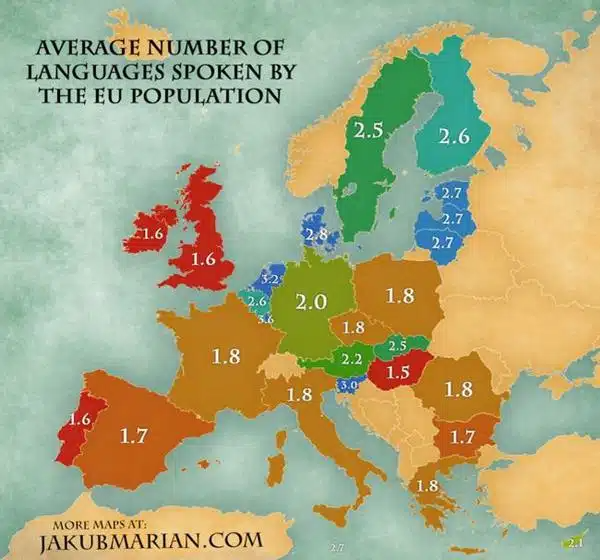
Au delà des 3 langues officielles, d'autres langues venant des pays voisins prennent de plus en plus de place dans le pays :
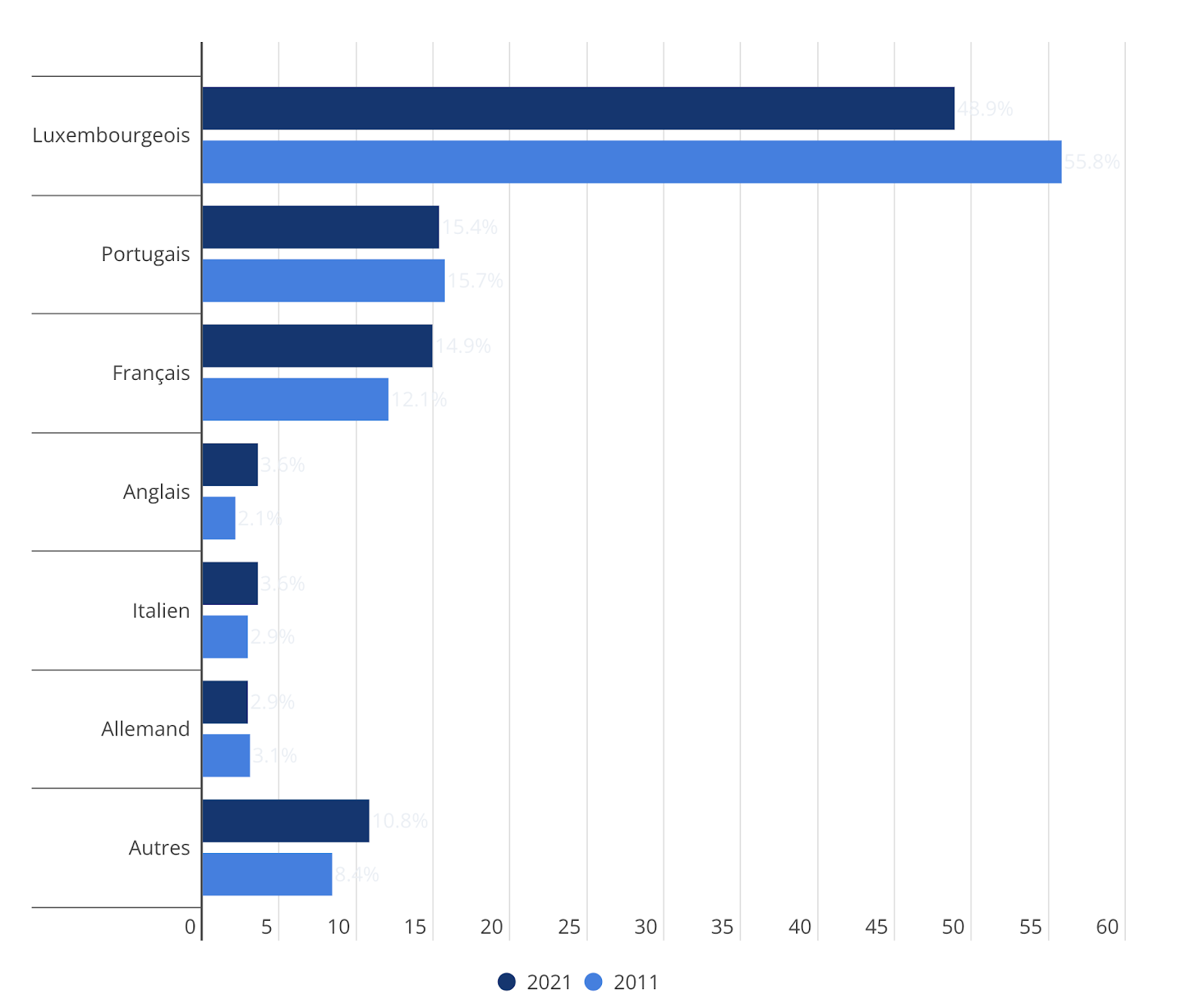
Depuis 2011, le Luxembourgeois est la langue la plus parlée, mais le portugais, l'italien ou encore l'allemand sont de plus en plus présentes, avec la quantité de travailleurs d'origine étrangère.
Le rôle du trilinguisme dans l’administration, l’éducation et les médias
Le trilinguisme luxembourgeois est profondément ancré dans tous les aspects de la vie quotidienne du pays, que ce soit dans son administration, son système éducatif ou ses médias. L'organisation du pays fonctionne en intégrant les différentes langues dans plusieurs aspects de la vie luxembourgeoise.
Administration publique
La loi du 24 février 1984 sur le régime des langues consacre le luxembourgeois comme langue nationale, tout en reconnaissant le français et l'allemand comme langues administratives. En effet, les actes législatifs sont généralement rédigés en français, tandis que l'allemand et le luxembourgeois sont utilisés dans divers contextes administratifs.
Par exemple, les débats parlementaires se déroulent principalement en luxembourgeois, ce qui reflète son rôle central dans la vie politique. Les citoyens peuvent interagir avec l'administration dans la langue de leur choix parmi les trois officielles.
Éducation
Le système éducatif luxembourgeois est conçu pour développer le multilinguisme dès le plus jeune âge. L'enseignement fondamental débute avec le luxembourgeois comme langue principale, servant de base pour l'alphabétisation.
À partir du cycle 2, l'allemand est introduit comme langue d'instruction, suivi du français au cycle 3. Les élèves sont alors dotés d'une maîtrise solide des trois langues. En 2015, 59 % des élèves du premier cycle de l'enseignement secondaire apprennent au moins deux langues à l'école, ce qui illustre l'importance du multilinguisme dans le parcours éducatif. Aujourd'hui, les Luxembourgeois parlent en moyenne 3,6 langues : une jolie performance.
Médias
La diversité linguistique du Luxembourg se reflète aussi dans les médias. Les journaux sont majoritairement rédigés en allemand, ce qui offre une couverture étendue des actualités nationales et internationales. La télévision et la radio diffusent à 80% en luxembourgeois, histoire de renforcer son usage quotidien et sa présence dans la culture populaire. Le français est également présent, notamment dans certaines publications et émissions, et a un rôle clé dans la communication et les affaires.
Le trilinguisme au Luxembourg est une caractéristique essentielle qui influence et enrichit tous les domaines de la société, de l'administration à l'éducation en passant par les médias, pour créer un environnement multilingue et inclusif.
Langues et marché de l’emploi au Luxembourg
Les langues les plus demandées par secteur d’activité
Le marché de l’emploi luxembourgeois est fortement influencé par la diversité linguistique du pays. Certains secteurs privilégient une langue plutôt qu’une autre, en fonction de leur clientèle et de leurs partenaires internationaux.
- Secteur bancaire et financier : l’anglais est indispensable en raison des nombreuses relations internationales
- Secteur public et juridique : le français domine dans les documents officiels et les échanges administratifs
- Commerce et hôtellerie : le multilinguisme est essentiel, avec une préférence pour le français et l’allemand
- Secteur technologique et informatique : l’anglais est souvent la langue de travail principale
- Secteur de la construction : ici, beaucoup de travailleurs parlent l'italien, le portugais, ou le français
Exemples concrets d’opportunités pour les multilingues
Être multilingue au Luxembourg est un avantage compétitif sur le marché du travail. De nombreuses entreprises recherchent des profils capables de jongler entre plusieurs langues.
Par exemple :
- Un employé dans une banque pourra être amené à échanger en français avec ses collègues, en anglais avec des clients internationaux et en luxembourgeois avec l’administration fiscale.
- Un serveur dans un restaurant devra s’adapter aux clients francophones, germanophones ou anglophones.
- Un développeur informatique travaillant pour une start-up internationale utilisera l’anglais en majorité tout en interagissant avec des administrations en français.
- Pour travailler au sein du gouvernement luxembourgeois, vous devrez obligatoirement parler la langue luxembourgeoise.
Témoignages
S'il y a une chose commune au Luxembourg, c'est bien celle-ci : tout le monde sait que parler plusieurs langues est une caractéristique très importante au Grand-Duché, au vu du nombre de nationalités présentes dans la région.
Mélanie, Policy Manager chez Foyer Global Health, partage son expérience : Pour moi, le plus compliqué c’était la langue, parce que je ne parlais pas très bien le français lors de mon expatriation à Paris. Il fallait que je trouve un travail. C’est ce qui a été le plus difficile. (témoignage recueilli sur foyerglobalhealth.com).
Tatiana, Communication Manager expatriée au Luxembourg, souligne : Ici, au Luxembourg, c’est très multiculturel. Il y a du français, de l’anglais, je ne savais pas au début quelle langue je devais parler. (témoignage recueilli sur foyerglobalhealth.com).
S’intégrer grâce aux langues au Luxembourg
L’importance culturelle des langues dans les interactions quotidiennes
Le multilinguisme ne se limite pas au monde professionnel au Luxembourg. Il est omniprésent dans :
- la vie quotidienne,
- les interactions sociales,
- les habitudes de consommation
- l’identité culturelle des résidents de la région.
Comprendre et utiliser plusieurs langues n’est pas seulement un avantage professionnel : c’est une nécessité pour s’intégrer dans la société luxembourgeoise.
La flexibilité linguistique reflète non seulement la diversité des résidents, mais aussi la volonté d’inclure chaque individu, quelle que soit sa langue maternelle. Si vous êtes expatrié et que vous connaissez quelques mots en luxembourgeois, vous améliorerez votre relation avec les habitants et favoriser une meilleure intégration sociale.
Les langues jouent un rôle dans la culture et les traditions locales. De nombreuses fêtes populaires, comme l’Oktavmäertchen ou la Schueberfouer, sont annoncées et célébrées dans les trois langues officielles.
Le multilinguisme est un marqueur identitaire au Luxembourg. Les résidents qui parlent plusieurs langues ont un signe d’appartenance plus ancré à la culture luxembourgeoise. Pour les nouveaux arrivants, c’est un défi mais aussi une opportunité d’intégration.
N’hésitez pas à être curieux et à exploiter les différentes langues pour mieux communiquer, mais aussi pour mieux comprendre l’histoire et les valeurs de ce pays multiculturel.
Ressources pour apprendre les langues parlées au Luxembourg
Apprendre une langue demande du temps et de la pratique régulière. Heureusement, au Luxembourg, il existe de nombreuses ressources pour aider les nouveaux arrivants à se familiariser avec le luxembourgeois, le français et l’allemand :
Cours de langues
Plusieurs institutions proposent des cours de langues pour les expatriés et les travailleurs souhaitant améliorer leur niveau linguistique :
- L’INL (Institut National des Langues) : l'INL propose des cours de luxembourgeois, français et allemand pour différents niveaux
- L’Université du Luxembourg : l'Université offre des programmes de formation linguistique adaptés aux étudiants et professionnels
- Les écoles privées et associations : certaines structures comme Prolingua ou Berlitz proposent des cours intensifs adaptés aux besoins professionnels
Plateformes en ligne
Pour ceux qui préfèrent apprendre à leur rythme, plusieurs applications et sites web permettent de progresser efficacement :
- Duolingo et Babbel : idéales pour débuter avec des bases grammaticales et du vocabulaire essentiel
- Memrise : met l’accent sur l’apprentissage interactif avec des vidéos de locuteurs natifs
- Mosalingua : recommandée pour mémoriser des phrases clés utilisées dans le quotidien et au travail
- Netflix : oui, regarder des films ou séries sur une plateforme de streaming en version originale peut grandement pour aider à apprendre une langue
Immersion et pratiques quotidiennes
L’un des moyens les plus efficaces d’apprendre une langue est l’immersion. Au Luxembourg, il existe plusieurs opportunités pour pratiquer activement :
- Rejoindre des groupes de conversation : de nombreuses associations organisent des rencontres linguistiques pour permettre aux expatriés de pratiquer avec des natifs
- Regarder des médias locaux : n’hésitez pas à lire les journaux luxembourgeois (Wort, L’Essentiel…), écouter la radio ou regarder des émissions locales pour vous habituer à l’accent et aux expressions courantes
- Participer à des événements culturels : assister à des festivals ou à des rencontres professionnelles permet d’améliorer son niveau tout en développant son réseau social. Plutôt intéressant comme technique
Conseils pour améliorer son niveau linguistique
Si vous devions donner 5 conseils pour améliorer son niveau linguistique, voici ce que l'on dirait :
- Pratiquer régulièrement : consacrer un peu de votre temps chaque jour à l’apprentissage et à l’exposition aux langues
- Écouter et lire en langue cible : regarder des émissions locales, écouter la radio, lire des articles en luxembourgeois, français ou allemand ou encore regarder des séries sur Netflix en version originale
- Interagir avec des locuteurs natifs : rejoindre des groupes de discussion ou échanger quotidiennement avec des collègues et amis
- Se fixer des objectifs : sans se mettre la pression, vous pourrez définir un niveau à atteindre et suivre les progrès (par exemple : apprendre une idée par jour, savoir tenir une conversation d'ici 3 mois)
- Ne pas avoir peur de faire des erreurs : l’apprentissage passe par la pratique et l’erreur est une étape naturelle du processus. Vous n'êtes pas obligés de parler parfaitement la langue, l'idée est surtout de savoir tenir une conversation et d'avoir une certaine fluidité
Conclusion
Le Luxembourg est un pays où le multilinguisme est bien plus qu’un simple atout : c’est une nécessité pour s’intégrer pleinement dans la vie professionnelle et sociale. Avec la langue luxembourgeoise, le français et l’allemand comme langues officielles, et l’anglais jouant un rôle clé dans certains secteurs, la diversité linguistique influence à la fois le marché du travail et les interactions quotidiennes.
Pour les expatriés et les travailleurs internationaux, maîtriser plusieurs langues ouvre de nombreuses opportunités et facilite l’intégration. Heureusement, de nombreuses ressources existent pour progresser, que ce soit à travers des cours, des plateformes en ligne ou l’immersion dans la culture locale.
En fin de compte, apprendre et utiliser différentes langues au Luxembourg est une expérience enrichissante, qui permet non seulement d’évoluer professionnellement, mais aussi de mieux comprendre et apprécier la culture unique de ce pays multiculturel.
Si vous recherchez un emploi au Luxembourg et souhaitez trouver une opportunité qui correspond à vos compétences linguistiques et professionnelles, Alleyesonme.jobs est la plateforme idéale. Elle vous permet de découvrir des offres adaptées à votre profil et de vous connecter aux recruteurs qui valorisent votre savoir-faire.
Questions fréquentes
Quelle langue est la plus utilisée au travail au Luxembourg ?
Le français est la langue la plus couramment utilisée dans l’administration et les services, tandis que l’anglais domine dans les secteurs financiers et technologiques.
Est-il nécessaire de parler luxembourgeois pour trouver un emploi ?
Non, mais cela peut être un atout selon le domaine d’activité. Dans le secteur public, la maîtrise du luxembourgeois est souvent requise.
Le trilinguisme est-il obligatoire dans tous les secteurs d’activité ?
Non, mais la maîtrise de plusieurs langues est fortement recommandée pour faciliter l’intégration et multiplier les opportunités professionnelles.